How to use WhatsApp messages as evidence in a custody case
Whether messages can be used, what makes them admissible, how to save and authenticate them, and how to present them so a judge can read them. General information about US practice, not legal advice.
By Martin Ferret · Published · Last updated
Can WhatsApp messages be used in a child custody case?

Generally, yes. Family courts see text and messaging app conversations all the time, and WhatsApp is treated like any other written message: what matters is not the app but what the messages show and whether their source can be established.
In a custody matter the question a judge keeps returning to is the best interests of the child. Messages tend to matter when they bear on that directly: how the parents communicate about the children, pickups and missed visits, schedules agreed and then changed, school and medical decisions, threats or harassment, and whether each parent supports the child’s relationship with the other.
Being able to use messages does not mean every message will be considered, or given weight. The judge decides what comes in and how much it counts.
Are WhatsApp messages admissible as evidence in court?
Admissibility is decided by the court, case by case. Across US jurisdictions, messages usually have to clear the same few hurdles as any other document:

- Relevance. The messages have to make a fact that matters to the case more or less likely.
- Authentication. Someone has to show the messages are what they are claimed to be: this conversation, between these people, unaltered. In federal courts this is Rule 901 of the Federal Rules of Evidence, and most states have a rule modeled on it.
- Hearsay. A message is an out of court statement. Statements made by the other party and offered against them are generally not treated as hearsay (an “opposing party’s statement” under federal Rule 801(d)(2) and similar state rules), which is one reason the other parent’s own messages are the ones most often used.
- Completeness. When one side offers part of a conversation, the other side can usually ask for the rest to be considered alongside it (federal Rule 106 and its state equivalents). Excerpts invite that request.
- How they were obtained. Messages from a conversation you were part of are a different matter from messages taken from someone else’s phone or account without permission, which can break the law and get the evidence excluded.
Some family courts apply these rules less strictly than a civil jury trial would, especially in temporary hearings. That is a reason to ask an attorney how your court handles them, not a reason to assume they will not be applied.
How do you save WhatsApp messages as evidence?
The goal is to keep the conversation complete and unaltered, in a form someone else can check. WhatsApp’s own export does this better than anything else on the phone, because it writes every message with its date, time and sender into a file.

- 1Do not delete the chat, the messages in it, or the app. Do not edit or forward messages to “clean them up”.
- 2Export the conversation from the phone. On iPhone: open the chat, tap the contact or group name, then Export Chat. On Android: open the chat, tap the three dots, More, then Export chat.
- 3Choose Attach Media if photos, videos or voice notes matter. Without media the file is smaller, but attachments become a line saying they were omitted.
- 4Send the ZIP to yourself or save it to Files, then copy it to a computer. Keep that original file exactly as it is, and work on copies.
- 5Write down which time zone the phone was set to when you exported. WhatsApp writes every timestamp in that zone and does not record which one it was.
- 6Keep the phone itself. Someone may later ask to see the conversation on the device it came from.
The full walkthrough, with what changes between iPhone and Android, is in how to export a WhatsApp chat. What the exported file contains, line by line, is described in the WhatsApp export format.
Can a WhatsApp screenshot be used as evidence?
Screenshots are used in court regularly, and they are also the easiest form of message evidence to attack. A screenshot shows only what fit on the screen, it can be cropped to remove context, and editing apps can fabricate a convincing one in a minute. Opposing counsel knows all three.
A screenshot is strongest as an illustration of a message that also exists in a complete export: the export carries the whole sequence with every timestamp, and the screenshot shows what it looked like on the phone. Relying on screenshots alone leaves the question of what sits between them open.
How do you authenticate WhatsApp messages for court?
Authentication only requires enough to support a finding that the messages are what they are said to be. In practice it is usually built from several of these together:
- Testimony from a participant that this is the conversation and that it has not been changed.
- The phone number and contact details attached to the account, and evidence that the other person uses that number.
- Content only the sender would know: names, places, plans and references to events the court has other evidence of.
- The other party admitting the messages, in a deposition, a request for admission or at the hearing.
- An inspection of the device, or in a contested case a forensic examiner’s report.
- A digest of the exported file, so anyone can confirm later that the file has not changed since it was produced. How that works is explained in SHA-256 file integrity.
A digest proves a file has not changed since the digest was taken. It says nothing about what happened before the export, such as messages deleted in the app. That part is covered by the testimony of the person who exported it.
How do you present text messages as evidence in court?
A judge in a busy family court reads what is easy to read. A conversation printed as it appears on a phone, hundreds of bubbles long, is hard to cite and harder to find a message in. What makes message evidence usable is the same as for any other exhibit:
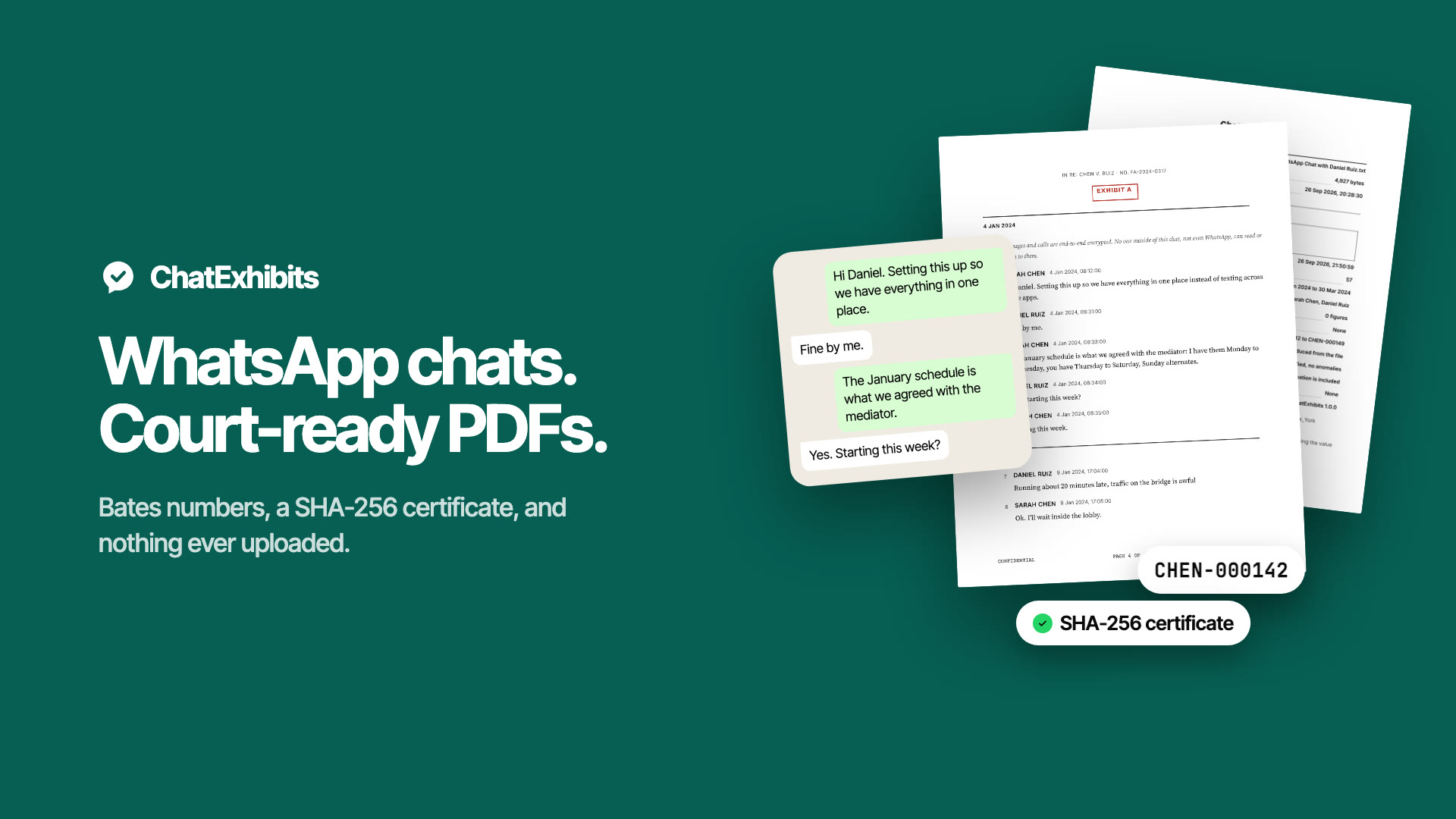
- The whole thread, in order. Chronological, with dates and times on every message, and nothing removed without saying so.
- Pages that can be cited. Page numbers that run across the production, usually Bates numbers, so that everyone can turn to the same page.
- A way to point at one message. A number per message, so a filing can cite the exact line rather than a page holding twenty.
- The key messages, separately. A short list or summary of the messages that matter, pointing into the full exhibit, rather than a highlighted printout of everything.
- The court’s own rules. Exhibit labels, how copies go to the other side, and e-filing limits on format and file size all vary by court.
This is what a ChatExhibits document is built to be. The sample exhibit shows one, page by page.
Can WhatsApp voice notes be used in court?
Voice notes are recordings the sender made and chose to send, which makes them different from secretly recording a phone call, where consent laws apply. Like other messages, they still have to be relevant and authenticated.
Courts generally prefer a written transcript beside the original audio. Keep the original files from the export (on iPhone and Android they are the .opus files in the ZIP), make sure every transcript is checked against the recording by a person, and keep the link between each transcript and the file it came from.
Can you subpoena WhatsApp for the other parent’s messages?
Usually that is not where the content comes from. WhatsApp messages are end-to-end encrypted, and WhatsApp states that it does not store messages once they are delivered. A subpoena to the company can produce limited account information, not the conversation itself.
The messages exist on the phones of the people in the conversation, and in their backups. That is why they normally reach a custody case through one of the participants, or through discovery: a request that the other party produce the relevant conversations, sometimes after a letter asking them to preserve them.
What mistakes weaken WhatsApp evidence in a custody case?
- Cropping, editing or retyping messages, even to make them easier to read.
- Showing only one side of an exchange, which invites the rest of it and the question of why it was left out.
- Deleting messages or the chat after a dispute has started.
- Taking messages from the other parent’s phone, account or backup without permission.
- Filing hundreds of unsorted pages and leaving the judge to find the five that matter.
- Forgetting that your own messages are in the same thread. The court reads both sides.
Where does ChatExhibits fit in a custody case?
ChatExhibits turns the export from step two above into a paginated PDF: every message in order with its date, time and sender, a number per message, Bates numbers on every page, voice notes transcribed for you to review, and a certificate carrying the SHA-256 digest of the file you exported. The conversation is read inside your browser and never uploaded.
It makes a document that is easier to file, cite and check. It does not decide, and cannot decide, whether a court will accept it: that remains the judge’s decision, and how to use it in your case is a question for your attorney.
Common questions
Can deleted WhatsApp messages be recovered for a custody case?
Sometimes. They may survive in an iCloud or Google Drive backup made before they were deleted, on the phone of the other person in the conversation, or through a forensic examination of the device. None of these is guaranteed, which is why exporting early matters.
Do judges actually read text messages in custody cases?
Judges read the messages that bear on the child, and they read what they can find. A short, organized exhibit with the key messages identified is far more likely to be read than a stack of screenshots.
Are WhatsApp messages discoverable in a custody case?
Generally, relevant messages can be requested in discovery like any other documents, and both parents may be asked to produce them. The scope and the procedure depend on the state and the court.
Can I use messages taken from the other parent’s phone?
Messages from a conversation you were part of are usually yours to produce. Getting into someone else’s phone, account or backup without permission can be illegal and can get the evidence excluded. Ask an attorney before using anything obtained that way.
How do I turn WhatsApp messages into a PDF for court?
Export the chat from the phone, then convert the exported file rather than printing screenshots. ChatExhibits reads the export in your browser and produces a paginated PDF with Bates numbers, a number per message and an integrity certificate.
Keep reading
- Export a WhatsApp Chat on iPhone or AndroidStep-by-step export instructions for iPhone and Android, what “Attach Media” changes, why WhatsApp Desktop cannot export, and what ends up inside the ZIP.
- WhatsApp Export Format: the TXT and ZIPWhat is inside a WhatsApp export: the two timestamp formats, the invisible direction marks, attachment lines on iOS and Android, and how media is named.
- What Is Bates Numbering? Format, ContinuityWhere the name comes from, what a Bates number looks like, why it runs continuously across a production, and what stamping one does not accomplish.
- SHA-256 File Integrity: Is a File Unchanged?What a hash is, why changing one byte changes the whole digest, how to compute one on macOS, Windows and Linux, and what a digest cannot tell you.